
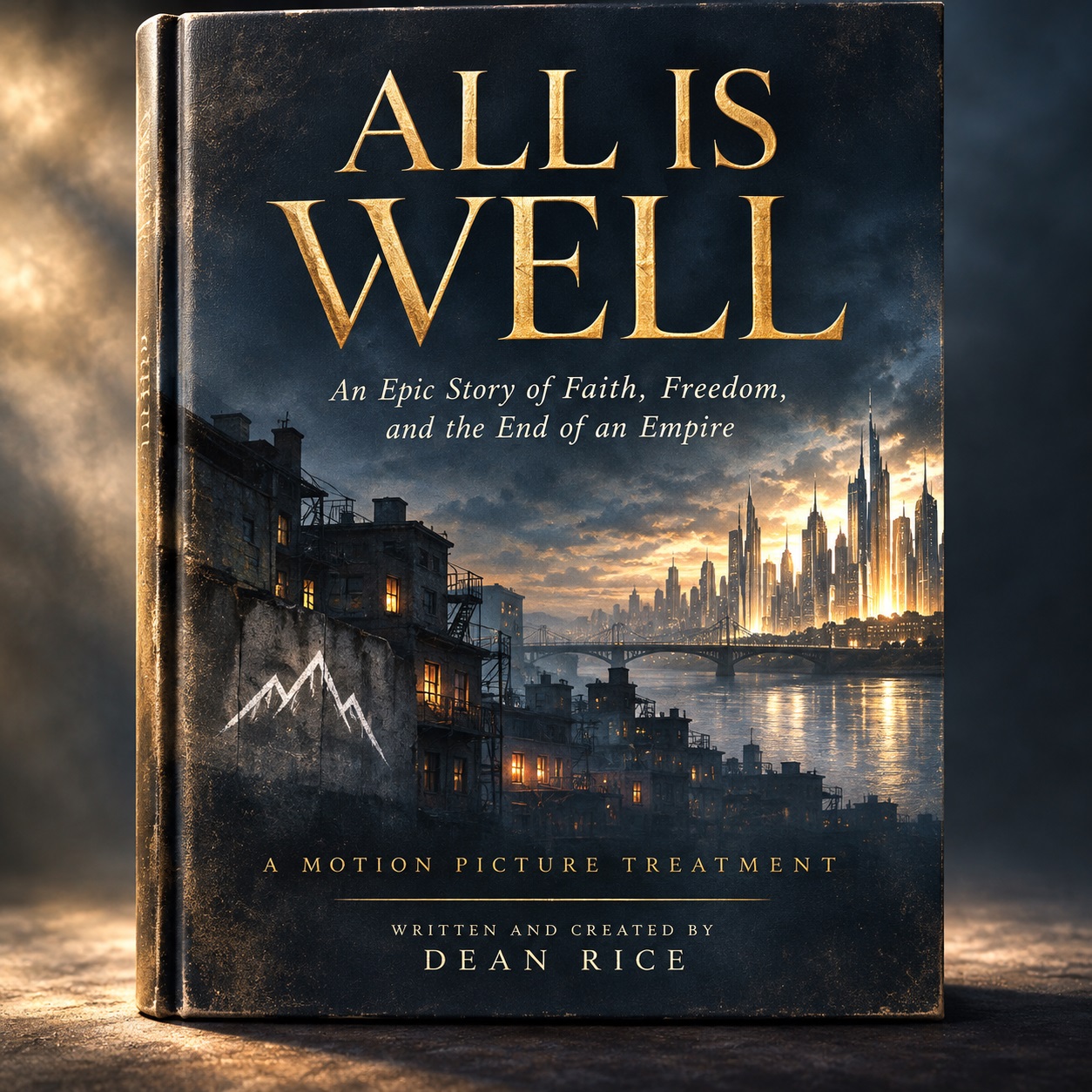
Treatment
ALL IS WELL
An Epic Story of Faith, Freedom, and the End of an Empire
A Motion Picture Treatment
Written and Created by Dean Rice
The world has survived its own destruction. But survival has come at a terrible price.
In the remnants of what was once New York City, a new civilization has risen from the ashes of a devastating world war. It is a civilization divided not merely by wealth or opportunity, but by the very definition of human worth.
On the island of Manhattan stands The Empire, a breathtaking monument to mankind’s ability to rebuild. Towering skyscrapers pierce the clouds. Wealth, technology, and unimaginable luxury surround those fortunate enough to live within its boundaries. Its citizens enjoy a life of privilege, security, and entertainment, largely untouched by the suffering that sustains their existence.
Across the river lies The Burg.
Here, the masses live under the authority of The Empire, providing the labor that keeps its magnificent towers standing. They build its buildings, maintain its infrastructure, and serve its citizens, only to return each evening to crowded neighborhoods where opportunity is scarce and hope is often scarcer.
They are called Serfs.
Among them is a young man named Aaron.
Barely twenty years old, Aaron, like every other Serf, is hard. He lives in a modest apartment with his aging grandmother, a woman whose unwavering faith has carried them through years of hardship. Their home is small, their possessions few, but within those walls survives something increasingly rare in their world: love, compassion, and the stubborn belief that tomorrow might still be better than today.
Aaron works in a bicycle shop, repairing the machines that have become the lifeblood of a population forbidden to own automobiles. He is intelligent, observant, and naturally gifted with words, though he has yet to discover the extraordinary influence his voice might someday carry.
For now, he is simply a young man trying to find his place in a world that seems to have decided his future before he was born.
Every Friday evening, The Burg comes alive with its greatest spectacle: the bicycle races.
Eight teams, representing the fractured communities of The Burg, compete in dangerous, high-speed contests that captivate audiences on both sides of the river. For the Serfs, the races offer a brief escape from the drudgery of everyday life. For the wealthy citizens of The Empire, they are entertainment, complete with extravagant gambling and lavish celebrations.
But beneath the excitement lies a troubling truth. The teams reflect the divisions that have taken root among the oppressed themselves. Neighborhoods, ethnic loyalties, rivalries, and old resentments keep the people of The Burg separated, even as they share the same suffering.
Aaron watches these races with fascination. He admires the courage of the riders, the loyalty of their teams, and the fleeting moments when ordinary men become heroes.
He longs to belong to something greater than himself.
Unfortunately, there are others who recognize that longing.
The streets of The Burg are increasingly controlled by gangs, organizations that promise protection, brotherhood, and purpose to young men who have little of any. One evening, Aaron encounters a charismatic young man known as Kool-Aid, whose easy humor and apparent friendship offer Aaron something he has been missing for much of his life: someone just to talk to.
Through Kool-Aid, Aaron is introduced to the Kingsmen, a powerful neighborhood gang led by a man called Scribe.
To Aaron’s surprise, Scribe is not the ruthless criminal he expected. He is thoughtful, respected, and genuinely concerned about the people around him. The Kingsmen offer a sense of family, a place where loyalty matters and where a young man might finally have a voice.
Aaron is drawn toward them.
His grandmother sees something else.
She has watched too many young men disappear into the violence that consumes their streets. She knows how easily the desire for belonging can become a lifetime of bondage. Each evening she prays for her grandson, asking God to protect him from dangers he cannot yet recognize.
Aaron loves his grandmother, but her faith sometimes feels like an answer to a question no one is listening to.
What good is prayer when the powerful grow richer, the poor grow desperate, and nothing ever seems to change?
Yet strange things are beginning to happen.
Throughout The Burg, an unusual symbol has appeared on walls, subway stations, and abandoned buildings: the outline of a mountain. No one seems to know who first painted it or what it means. Some dismiss it as graffiti. Others whisper that it represents a place beyond The Empire’s reach, a place where freedom might still exist.
Aaron begins noticing the symbol everywhere.
And then, one evening, as he stands in a subway station preparing to meet his new friends, he hears something that stops him cold.
A voice.
Quiet. Unmistakable. Calling his name.
There is no one nearby who could have spoken.
For a moment, the noise of the city seems to disappear. Aaron looks around, frightened and bewildered, unsure whether he has imagined it.
The voice warns him to listen to his Grandma.
But Kool-Aid arrives, the moment passes, and Aaron continues toward the Kingsmen.
He has no way of knowing that this seemingly insignificant decision will place him on a path toward events far greater than the neighborhood rivalries of The Burg.
Meanwhile, tensions throughout the city are rising.
The Empire’s rulers demand greater productivity from the Serfs. New restrictions threaten their already limited freedoms. The gangs grow increasingly restless, and the fragile peace between rival communities begins to unravel.
Something is changing.
Aaron feels it in the streets, in the conversations of his neighbors, in the desperate prayers of his grandmother, and in the mysterious mountain symbols that seem to multiply overnight.
He cannot explain the feeling, but he is beginning to suspect that his life is meant for something more.
What Aaron does not know is that his story began long before he was born, that the forces shaping his future reach far beyond the streets of The Burg, and that the greatest secret of his life lies not among the oppressed, but within the very heart of the civilization that enslaves them.
For high above the suffering streets, surrounded by unimaginable wealth and privilege, lives a prince of The Empire—a young man who possesses everything Aaron has ever been denied.
His name is Moses.
And he is Aaron’s brother.
Categories: Dreams
You must be logged in to post a comment.